
Businesses planning their digital advertising strategy often face the same question: which channel is more effective – Google Ads or Facebook Ads?
It’s natural to look for a single “best” option, but in reality, there is no one-size-fits-all answer.
Google Ads and Facebook Ads operate on different principles, play distinct roles across the customer journey, and solve different business challenges.
That’s why the right choice depends not on the platform itself, but on your business goals, the type of product or service you offer, your target audience, and your current market situation.
In this article, we’ll break down the key differences between these channels, explore when each performs best, and help you understand how to use them strategically.
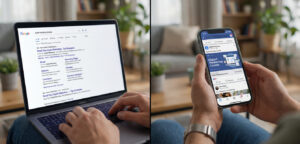
Key differences between Google Ads and Facebook Ads
Google Ads
Google Ads is an advertising platform that allows you to display ads in Google search results, across Google partner networks, on YouTube, and other platforms. Its key advantage is the ability to capture existing user intent.
Ads are shown when users are already actively searching for a solution. These can range from broad to highly specific queries, such as “air conditioner installation,” “accounting services in Vilnius,” “buy a bicycle online,” or “Samsung S25 Ultra.”
In this case, Google Ads acts as a fast way to appear in front of the user at the exact moment they’re ready to take action—whether that’s making a purchase, submitting an inquiry, or making a call.
It’s important to understand that search advertising is just one of the capabilities of Google Ads. The platform also allows you to reach users in other ways:
- through display advertising campaigns,
- through video advertising on YouTube,
- through demand generation campaigns,
- through Performance Max (hybrid) campaigns.
Display, YouTube, and Demand Gen campaigns typically work in a similar way to Facebook Ads—ads are shown based on users’ interests, behaviors, or demographics. In this case, the audience is usually “cold,” meaning they are not yet actively searching for a solution and are not ready to take action.
Meanwhile, Performance Max campaigns combine multiple channels and can reach both cold audiences and users who are already actively looking for a solution.
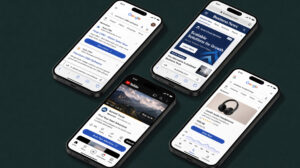
Key strengths of Google Ads:
- reaches users with clear intent (especially through search campaigns);
- a highly effective channel for driving sales and generating leads;
- allows you to see results quickly;
- makes it easy to measure return on investment (ROI);
- allows you to capture existing demand (search campaigns) while also creating demand (Display, YouTube, Demand Gen).
Facebook Ads
Facebook Ads (including Instagram ads) works a bit differently. Here, ads are shown not based on what a user is actively searching for, but on who they are: their age, interests, lifestyle, online behavior, and previous interactions with your business.
This is a particularly powerful channel when you want to:
- introduce your brand to new audiences;
- introduce a new product or service to the market;
- create demand or build problem awareness;
- stay connected with potential customers.
Facebook Ads It often reaches users before they even realize they need your solution. That’s why this channel is especially effective for visual, emotional, or more impulse-driven purchases.
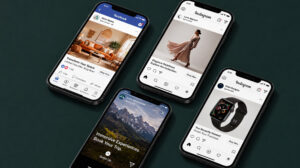
Key strengths of Facebook Ads:
- highly precise audience targeting;
- strong visual and emotional impact;
- highly effective for building awareness and generating demand;
- supports both video and static formats, with text in and above the creative, allowing you to communicate more value to the user;
- highly effective for remarketing.
When does Google Ads perform best?
Google Ads typically delivers the best results when:
- your product or service is actively being searched for online;
- the solution is needed immediately;
- your primary goal is to generate leads, calls, or sales;
- your website is technically sound and optimized for conversions;
This channel works particularly well for both B2B and B2C businesses, as it captures existing demand and allows you to reach potential customers quickly. Because the audience is typically “warm” and has clear intent, Google Ads often delivers a higher return on ad spend (ROAS) compared to social media advertising.
When does Facebook Ads perform best?
Advertising on Facebook and Instagram is typically more effective when:
- the goal is to increase brand awareness;
- you are introducing a new product or service;
- you want to reach a specific audience based on interests or lifestyle;
- the solution is not urgent or immediately needed;
- the message can be delivered in a visual and creative way.
This channel is particularly well suited for e-commerce, fashion, beauty, leisure, training, and lifestyle products, as well as for longer purchase journeys.
Advertising on Facebook and Instagram is especially effective when purchasing decisions are driven not only by rational need, but also by emotion and visual appeal. For example, a user might actively search for a phone charger on Google Ads because they simply need one. But on social media, they may become interested in a product they hadn’t even considered before—such as a new dress or another visually appealing purchase.
This doesn’t mean these channels work in only one way. Facebook Ads can also reach users who are already looking for a solution, while Google Ads can help drive more impulse-driven purchases. However, in most cases, Facebook Ads acts as a channel that builds demand, sparks interest, and gradually grows trust in your brand.
Why should you combine Google Ads and Facebook Ads?
The best results are usually achieved not by choosing a single channel, but by combining them based on funnel logic. At different stages, Google Ads and Facebook Ads serve different roles and complement each other. For example, imagine a Lithuanian clothing brand selling minimalist garments made from natural materials online.
- The customer journey begins with the awareness stage (TOFU – top of the funnel), where they are not yet actively searching for a specific brand, product, or service. At this stage, advertising on Facebook and Instagram is particularly effective, as it allows you to segment audiences based on interests, behaviors, or similarities to your existing customers. These ads can target people interested in fashion, minimalist style, or sustainable clothing. Creatives typically include visual banners, short videos, and collection showcases. At the same time, on Google Ads, you can run Demand Gen, YouTube, and Display campaigns to reach a broader audience and introduce your brand. The main goal at this stage is to build demand and increase brand awareness.
- In the middle of the funnel (MOFU), the audience already recognizes a problem and is actively looking for more information and potential solutions. Users may enter queries into Google such as “minimalist clothing,” “cotton t-shirts,” “cashmere sweater,” or “natural fabric clothing.” At this stage, search campaigns within Google Ads become especially important, allowing you to appear in front of users at the exact moment they are actively searching for a product or service. At the same time, Facebook Ads can show ads to people who have already visited your website or interacted with your brand content—for example, showcasing specific products, styling ideas, or customer reviews.
- At the bottom of the funnel (BOFU), the focus shifts to decision-making and encouraging users to take a specific action. At this stage, the user is already close to making a purchase. They may have viewed a specific sweater, added it to their cart, or returned to the website multiple times—but haven’t completed the final action yet. This is where remarketing campaigns on both Facebook Ads and Google Ads are especially effective. Users can be shown ads featuring the products they viewed, a limited-time offer, or free shipping. This helps remind them about the product and encourages them to complete the purchase.
- The sales funnel doesn’t end with the conversion. Once a customer has made a purchase, both channels can be used to drive additional sales (cross-sell, upsell) and strengthen loyalty. For example, Facebook Ads can be used to showcase new collections or styling ideas based on products the customer has already purchased. Meanwhile, Google Ads can help capture repeat searches when the customer is looking for similar items again. This approach encourages repeat purchases and increases customer lifetime value.
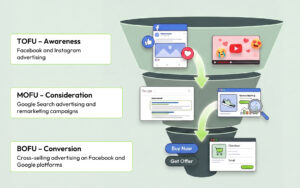
Can running ads only on Google Ads or only on Facebook Ads be profitable? Yes—but in many cases, the results are slightly weaker than when these channels are used together. Google Ads and Facebook Ads are not competitors. When combined, they cover the entire customer journey—from the first touchpoint to repeat purchases. That’s why the key question is not which channel to choose, but how to align them into a cohesive and profitable advertising strategy.

